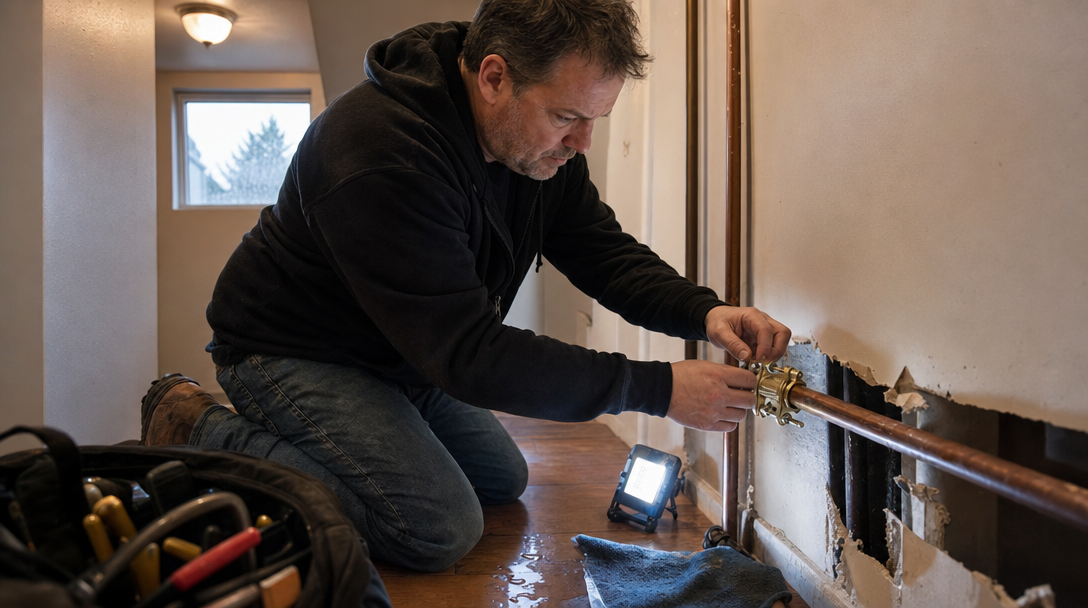
Every winter it goes the same way. We get a stretch of clear, still nights in the low twenties — usually the second week of January — and the phone starts at about 7:30 in the morning. Somebody turned on a faucet, got nothing, and now they are standing in a hallway wondering whether to be worried. By 9 a.m. the ice plug has thawed just enough to open the split, and the worry is justified.
Freezing pipes are one of the few plumbing emergencies that are almost entirely preventable, and the prevention is cheap. A weekend of work in October costs less than the drywall alone on a burst supply line. Here is what actually matters in Snohomish County houses, in the order it matters.
Why our freezes break pipes when colder places don't
People who move here from Montana or Minnesota are always surprised that a 22°F night in Granite Falls does more damage than a 5°F night where they came from. There are three reasons for that.
First, houses built for a mild climate are built thin. A lot of the older stock around Granite Falls, Lake Stevens, and the county's rural parcels has an uninsulated crawlspace, plumbing run in an exterior wall cavity, or a hose bib that was never frost-proof to begin with. Nobody designed for a hard freeze because a hard freeze was a once-every-few-years event.
Second, our cold snaps come with wind out of the Fraser Valley. Moving air pulls heat out of a crawlspace far faster than still air at the same temperature. An open foundation vent on the north side of a house is a heat exchanger pointed at your water lines.
Third — and this is the one that gets people — the pipe doesn't burst where it froze. Ice forms a plug, the plug keeps expanding, and the pressure builds in the closed section of line between that plug and a shut faucet. The pipe fails at its weakest point, which might be six feet away at a fitting. That is why "the pipe under the kitchen froze" so often ends with water coming through a ceiling on the other side of the house.
Know where your main shutoff is before you need it. If you can't find it in the dark in under a minute, that is the single highest-value thing to fix this week. Most homes here have it in the crawlspace near the front hose bib, in the garage, or at the meter box by the street.
What to do before it gets cold
Disconnect the garden hoses
This is the number one cause of burst hose bibs, and it takes four minutes. A hose left connected traps water in the bib. Even a frost-free sillcock — the kind with the long stem that shuts off inside the heated envelope — cannot drain if there is a hose holding water against the seat. Pull the hoses in October, drain them, and store them.
Insulate the pipes that are actually at risk
You don't need to wrap the whole house. The lines worth insulating are:
- Anything in the crawlspace, particularly runs near a foundation vent or along the rim joist
- Anything in the garage, especially the line feeding a utility sink or a garage-wall hose bib
- Anything in an unheated attic space, which around here usually means a run feeding an upstairs bath
- Any line in an exterior wall — you often can't get to these, which is why the cabinet trick below matters
Foam sleeve from any hardware store is fine. Get the size right — the sleeve should close fully around the pipe with no gap — and tape the seams. Pay attention to elbows and tees, because that's where people leave two inches bare and that's exactly where it freezes.
Close the foundation vents, but not permanently
Foam vent blocks are a few dollars each. Put them in when the forecast turns, pull them out in spring. Leaving crawlspace vents sealed year-round in our climate invites a moisture problem, which is a slower and more expensive kind of damage than a frozen pipe. If you have automatic vents that open and close on temperature, check that they still actuate — the springs give out after about a decade.
Find and label the main shutoff
Tag it. Hang a bright zip tie on it. Show everyone in the house. When there's water coming out of a ceiling, nobody is calmly reading a diagram.
What to do during a cold snap
When the overnight low is forecast below about 25°F, a few things are worth doing that night:
- Open the cabinet doors under kitchen and bath sinks that sit on an exterior wall. Room air keeps that cavity above freezing. It looks silly and it works.
- Run a pencil-thin drip from the fixture farthest from where the water enters the house — usually an upstairs bath or the far end of a rambler. Moving water freezes at a much lower temperature, and more importantly the open faucet gives expanding ice somewhere to go instead of building pressure.
- Keep the heat on and consistent. Setting back to 55°F overnight to save money is a bad trade during a freeze. Hold at 65°F.
- If you're leaving town, either keep the heat at 60°F minimum or have the system drained properly. An empty house with the furnace off is how we end up finding two weeks of water damage.
If a pipe is already frozen but hasn't burst
You'll know because a faucet gives you nothing, or a trickle, while other fixtures work normally. You have a window here — act on it.
- Leave the faucet open. As the plug melts, the water needs an exit. Closing the tap while thawing is how a frozen pipe becomes a burst pipe.
- Find the frozen section. Follow the line from the dead fixture back toward the water source and feel for the cold spot. Frost or condensation on the outside of the pipe is a giveaway.
- Apply gentle, even heat. A hair dryer, a heat gun on low, a space heater aimed at the area, or hot towels wrapped around the pipe. Work from the faucet side toward the frozen section, never the other way — you want the melt water to have an open path out.
- Stay with it. Do not leave a heat source running unattended near floor joists and insulation.
What not to use, ever: a propane torch, a blowtorch, a kerosene heater, or a charcoal anything. Open flame in a crawlspace is how a plumbing problem becomes a house fire, and torching a frozen pipe can flash the trapped water to steam and rupture the line in your hands. We're not being dramatic — this happens every winter somewhere in the county.
If it already burst
Shut the water off at the main. Then open the lowest faucets in the house — a basement utility sink, a downstairs tub — to drain the system and drop pressure on the broken section. Kill power to any circuit near the water if you can do it safely from a dry spot. Then call.
Get photos before you clean anything up, for the insurance claim. And move what you can out of the water — dry-out is usually a bigger bill than the pipe repair, and the difference between a small remediation and a big one is often just how fast the wet stuff got picked up off the floor.
Shut off the main, then call (360) 488-8553. We run a 24/7 emergency line for exactly this, and a real plumber picks up. More on how that works on our emergency plumbing page.
The permanent fixes worth budgeting for
If you've had a freeze scare more than once, the underlying problem is worth solving rather than managing every December:
- Swap standard hose bibs for frost-free sillcocks. Straightforward job, big reduction in risk.
- Re-route the truly bad runs. Sometimes a supply line was pulled through an exterior wall or across an open crawlspace because it was the short path during construction. Moving it into conditioned space fixes the problem permanently.
- Insulate and air-seal the crawlspace properly — rim joist included. This helps your heating bill the other eleven months of the year too.
- Heat tape on the runs that can't be moved, installed to the manufacturer's spec with a proper thermostat. Self-regulating cable, not the cheap constant-wattage stuff, and never wrapped over itself.
None of this is glamorous work and none of it shows up in a listing photo. But we have pulled enough soaked insulation out of enough crawlspaces in January to tell you it is the best money a homeowner in this county spends.

Owner-operated, licensed, bonded and insured, working out of Granite Falls and serving all of Snohomish County. Questions about your own place? Call (360) 488-8553 — you'll get a plumber, not a call center.