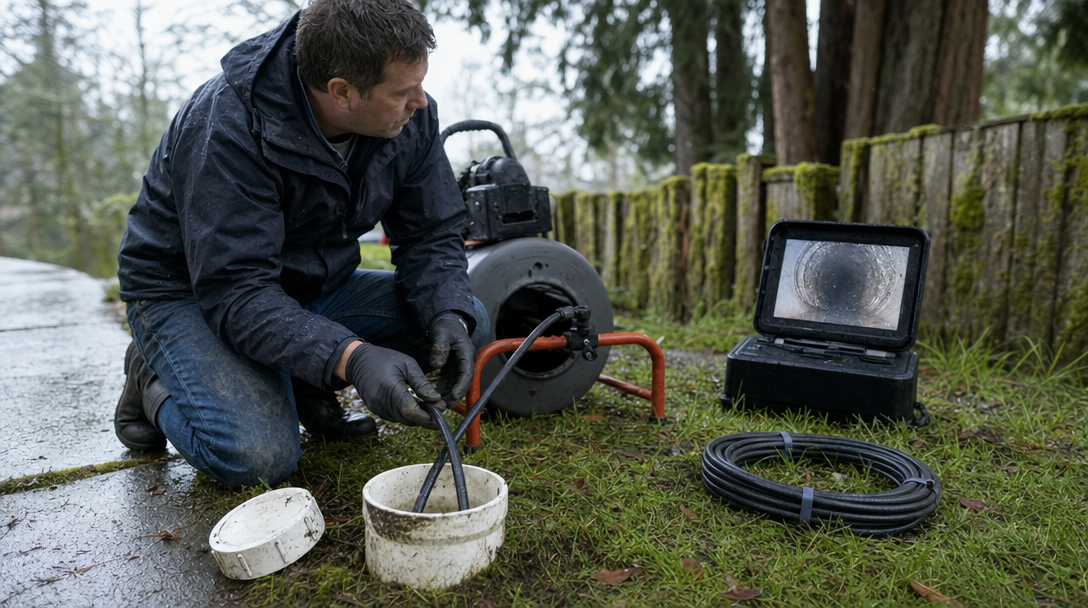
There's a persistent piece of folklore that tree roots crack sewer pipes. They don't, or at least they very rarely start it. Roots are opportunists. They find a joint that's already leaking, or a crack that already exists, and they exploit it. By the time you have a root ball in your line, the pipe had a problem first — and that distinction matters a lot when you're deciding how to fix it.
Around here the usual suspects are big-leaf maple, cottonwood, willow, and Doug fir. Maple and cottonwood are the aggressive ones. A mature maple's root system extends far past its drip line, and it is very good at following a moisture gradient underground.
How it actually starts
A sewer line carries warm, nutrient-rich water. When a joint weeps even slightly, that moisture and vapor escape into the surrounding soil. Roots grow toward it — not because the tree "senses the pipe," but because that's the wettest, richest soil available and root growth follows those conditions.
When a root hair reaches the gap, it goes through. Inside the pipe it finds ideal conditions and thickens. As it thickens it pries the joint wider, which admits more roots, and the thing snowballs. What starts as a hairline seep becomes a mass that catches every bit of paper and grease that comes down the line.
Which is why the pipe's material and age tell you most of what you need to know before we ever put a camera down it.
What's in the ground under Snohomish County
Clay (vitrified clay tile) — pre-1960s
Short sections, roughly three feet each, with a mortared joint at every seam. That's a lot of joints, and mortar doesn't stay sealed for seventy years. Clay is the classic root-intrusion pipe. It's also brittle, so ground movement and root pressure crack it. Common in older Everett and Snohomish neighborhoods.
Orangeburg — roughly 1945 to 1972
Bituminized fiber pipe, which is essentially tar-impregnated wood pulp. It was cheap and it was rated for fifty years, optimistically. Every bit of it is now past that. Orangeburg doesn't crack so much as deform — it ovalizes and delaminates, and the inside blisters closed. If a camera shows Orangeburg, we're not talking about repair. We're talking about replacement scheduling. Some post-war housing stock in the county still has it.
Cast iron — mid-century through the 1970s
Strong pipe, but it scales and corrodes internally. The rough interior catches debris, and the bottom of the pipe channels out first. Roots find corrosion holes readily.
ABS and PVC — 1970s onward
Glued joints, long runs, few seams. Modern plastic sewer pipe rarely has root problems unless something disturbed it — settlement, a bad bedding job, someone's excavator, or a joint that wasn't properly solvent-welded on install day. If you have a root problem in PVC, there's a specific cause and the camera will show it.
Warning signs, in order of how early they show up
- Gurgling from a toilet or tub when a different fixture drains. That's air being displaced past a partial obstruction — often the earliest sign, and the easiest to ignore.
- Multiple slow fixtures at once. One slow sink is a local clog. The whole house slowing down is a main line problem.
- The lowest fixture backing up first. A basement floor drain or a first-floor toilet is where a main line blockage shows itself.
- A patch of lawn that's greener, lusher, or soggier than the rest — especially in a line from the house toward the street. That's your sewage fertilizing the yard.
- Recurring clogs on a schedule. If you're getting the line snaked every eight to twelve months, you don't have a clog problem. You have a pipe problem that snaking is managing.
- Sewer smell in the yard, or a soft depression in the ground over the line's path.
Why a camera scope is the whole decision
Here's our honest position: anyone who quotes you a sewer replacement without scoping the line first is guessing, and you should get a second opinion. And anyone who clears a recurring blockage without scoping is selling you the same service again next year.
A scope answers questions nothing else can:
- What material is the pipe? Determines whether repair is even on the table.
- Where exactly is the problem? We locate it from above ground with a sonde, so you know if it's eight feet out or forty — the difference between a small dig and one that crosses your driveway.
- How many defects are there? One bad joint is a spot repair. Six along the run means the whole line is at the end of its life.
- Is there a belly? A sagged section holding standing water will keep collecting solids no matter how many times it's cleared. Bellies don't get fixed by cleaning, ever.
- How much pipe wall is left? Determines whether a trenchless liner has anything to bond to.
Post-clearing scopes matter too. Cutting through a root mass gets flow back, but it doesn't tell you what the pipe looks like behind the roots. We scope after clearing, on video, and you watch it with us.
A sewer scope before closing is one of the best-value inspections available. Standard home inspections do not include it, and a sewer replacement discovered after closing is entirely yours. If you're looking at anything pre-1980 with a big maple in front, scope it.
The repair options, cheapest to most involved
Cabling (snaking)
A cutting head on a flexible cable bores through the obstruction. Fast, inexpensive, restores flow today. It cuts a channel through the root mass rather than removing it, so the roots regrow — typically within a year on an active intrusion. Right answer for an emergency backup; wrong answer as a permanent plan.
Hydro jetting
High-pressure water on a rotating nozzle that scours the pipe wall, removing roots, grease, and scale rather than just punching through. Much more thorough and buys considerably more time. Requires a pipe in sound enough condition to take the pressure — which is another reason we scope before jetting rather than after.
Spot repair
Dig up the specific failed section and replace it. Sensible when the scope shows one localized defect in an otherwise healthy line, and when the spot is somewhere reachable rather than under a slab or a mature tree.
Trenchless lining (CIPP)
A resin-saturated liner is pulled through and cured in place, forming a new jointless pipe inside the old one. No trench across your yard, and jointless means no root entry points. Needs the host pipe to be structurally intact enough to support it — good for cracked clay, not viable for collapsed Orangeburg.
Pipe bursting
A bursting head is pulled through the old line, fracturing it outward while drawing new HDPE in behind. Handles pipe too far gone for lining, and only needs access pits at each end. Not workable everywhere — other utilities in the trench path can rule it out.
Full open-cut replacement
Trench it, replace it. Most disruptive and usually most expensive once restoration is counted, but sometimes the only real option — multiple failure points, bad grade needing correction, or a collapse.
Keeping it from happening again
If you have mature trees and an older line, a maintenance schedule beats an emergency. Jetting every eighteen to twenty-four months keeps an intrusion managed at a predictable cost while you plan for the real fix on your own timeline instead of on a Sunday night.
Beyond that: don't plant maple, willow, or cottonwood over the sewer path — and know where that path is before you plant anything. Keep grease out of the drain, since a rough or root-lined pipe catches it and grease plus roots is the combination that produces genuine backups. And skip the copper sulfate root killers; they're marginal on an established mass and hard on your soil and septic biology.
Full detail on scoping, jetting, and trenchless work is on our drain and sewer page. If you've got an active backup right now, that's an emergency call — (360) 488-8553, any hour.

Owner-operated, licensed, bonded and insured, working out of Granite Falls and serving all of Snohomish County. Questions about your own place? Call (360) 488-8553 — you'll get a plumber, not a call center.