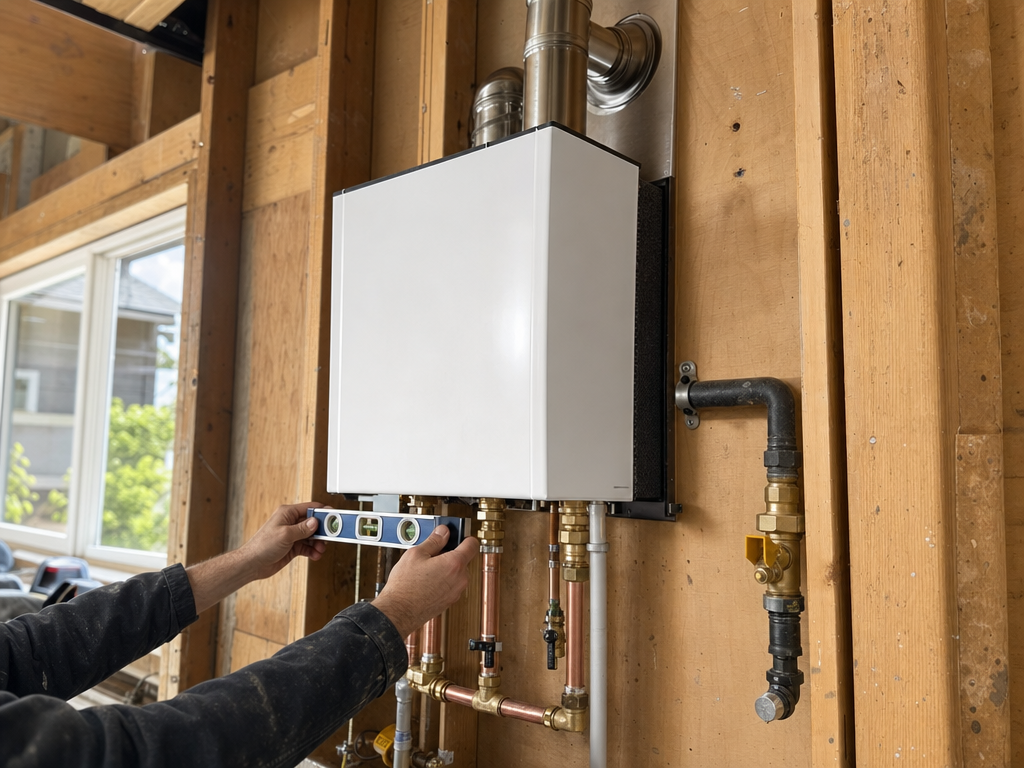
We install both. We have no incentive to push you toward either one, and the tankless conversions we turn down are a meaningful share of the ones we get asked about. So here is the honest version, including the part where the math doesn't work.
The short answer: tankless is excellent for a specific kind of household in a specific kind of house, and mediocre value for everyone else. The trouble is that the marketing is aimed at everyone, and the numbers quoted in it come from parts of the country with much warmer groundwater than ours.
The Pacific Northwest problem: cold water in, cold water in
A tankless heater doesn't store hot water. It heats water on demand as it passes through a heat exchanger, which means its output is governed by one equation: how many degrees it can raise the water, at how many gallons per minute. That's called temperature rise, and it is the whole ballgame.
Incoming groundwater in Snohomish County runs roughly 45–50°F in winter. In Phoenix it's around 70°F. If you both want 120°F at the tap, you need a 70–75 degree rise and they need 50. Same unit, same gas line, and you get substantially less hot water out of it than the brochure implies — because the brochure's flow rate is usually quoted at a much gentler rise.
A 199,000 BTU unit that's rated 9+ GPM in marketing copy delivers closer to 4.5–5 GPM at our winter temperature rise. That's a shower and a sink, comfortably. It is not two showers and a dishwasher in January.
This is why we size conservatively and why we almost always land on a 199k BTU unit for a normal family home here. A smaller unit that would be fine in Sacramento will leave you with a lukewarm shower in February, and the homeowner will — correctly — conclude that tankless is a scam. It isn't a scam. It was undersized for the climate.
What the conversion actually costs
The unit is not the expensive part. The infrastructure around it usually is. Every conversion needs some subset of the following, and which subset you need is why a real quote requires someone standing in your utility room.
Gas line upsizing
This is the big one. A typical 40-gallon tank draws 30,000–40,000 BTU. A tankless draws up to 199,000. That's not a small step up, and the existing half-inch line feeding your old tank is frequently not adequate — especially once you total it against the furnace, range, and dryer already on the system. Running a properly sized line from the meter is often the single largest line item in the quote.
Venting
A condensing tankless can't use your old B-vent. It needs sealed stainless or PVC venting, typically out a sidewall, routed to code clearances from windows, doors, and soffits. If your water heater sits in the middle of the house, that vent run gets involved.
Condensate drainage
Condensing units produce acidic condensate. It needs a drain path and, in most jurisdictions, a neutralizer before it goes into your waste line. Small item, frequently forgotten in cheap bids.
Electrical
Gas tankless units need power for the controls and fan. Often that means a new dedicated circuit to a spot that never had one.
The efficiency question, honestly
Tankless is genuinely more efficient than a standard tank. There's no standby loss — you're not keeping fifty gallons hot around the clock so it's ready at 6 a.m. Condensing units hit efficiency ratings a conventional atmospheric tank can't approach.
But the savings are on gas, and gas is not the expensive utility in this state. For a typical household the realistic annual savings run modest — enough to matter over twenty years, not enough to pay off a full conversion on energy alone in any timeframe that should drive the decision.
So if someone tells you a tankless "pays for itself in five years," ask them to show the arithmetic with our groundwater temperature and our gas rates. It generally doesn't.
The one place the efficiency argument does get strong: if you're replacing an already-dead tank and you were going to spend the money anyway, the incremental cost of going tankless is much easier to justify than the full replacement cost of a tank that's still working fine.
When we say yes
- You run out of hot water and it bothers you. This is the real reason to convert, and it's a perfectly good one. Back-to-back showers, a big soaking tub, a full house at the holidays — a correctly sized tankless simply does not run out. That's worth paying for as a comfort upgrade, and we'd rather you buy it for that reason than for a payback calculation that won't materialize.
- You need the floor space. Getting fifty gallons of tank out of a small utility room or a garage corner is a real gain, especially in an ADU or a compact remodel.
- You're staying seven-plus years. The longer service life starts to count, and you get to enjoy what you paid for.
- The infrastructure is already close. If the gas line is adequate, an exterior wall is right there for venting, and there's power nearby, the conversion cost drops a lot and the decision gets easy.
- You'll actually maintain it. More on this below — it's the condition most people skip past.
When we say no — or at least "probably not"
- You're happy with your hot water. If nobody in the house has ever run out, you're solving a problem you don't have.
- You're selling in two or three years. You won't recover the conversion in the sale price. Put in a good high-efficiency tank.
- The gas and venting work is extensive. When the infrastructure runs a large fraction of the total, we'll usually tell you to put a quality tank in and spend the difference somewhere it does more for you.
- Budget is genuinely tight. A new tank is dramatically cheaper today, and there is no shame in the right answer being the affordable one.
- You won't descale it. An unmaintained tankless underperforms a well-maintained tank and costs several times as much. This is the most common way a good conversion goes bad.
The maintenance nobody mentions at the point of sale
Tankless units need an annual descale. Water passes through a narrow heat exchanger at high temperature, and mineral plates out on those surfaces. Scale insulates the exchanger, which drops efficiency, which triggers error codes, which eventually kills the unit — and voids the warranty, because most manufacturers require documented service.
The service is straightforward: circulate descaling solution through the exchanger via the isolation valves, clean the inlet filter, check combustion. An hour or so annually. Skip it for five years running and you have converted a twenty-year appliance into a ten-year one while paying tankless prices.
Make sure whoever installs yours puts proper isolation valves on it. Without them, the annual service turns into a much bigger job every time.
PSE, Snohomish County PUD, and federal energy credits frequently apply to high-efficiency tankless and to heat pump water heaters, and they can move the math meaningfully. Programs change, so check current terms — we'll point you at the right paperwork when we quote.
The option people forget
If the reason you're considering tankless is efficiency rather than endless hot water, look hard at a heat pump water heater first. It's a tank — it keeps a tank's simplicity and tolerates neglect far better — but it runs two to three times more efficiently than a standard electric unit, and rebates on them are often the best available.
The catches: it needs adequate air volume around it (a garage or basement, not a sealed closet), it blows cold air into that space, and it makes a low hum. In a Snohomish County garage, none of that is usually a problem. For a lot of the houses we work in, it's quietly the best answer of the three, and it's the one almost nobody asks about.
Whichever direction you're leaning, we'll come look at your gas line, venting path, and electrical before quoting anything — see the water heaters page for how that goes, or read up on how long your current unit likely has left if you're trying to decide whether you're on a deadline.

Owner-operated, licensed, bonded and insured, working out of Granite Falls and serving all of Snohomish County. Questions about your own place? Call (360) 488-8553 — you'll get a plumber, not a call center.