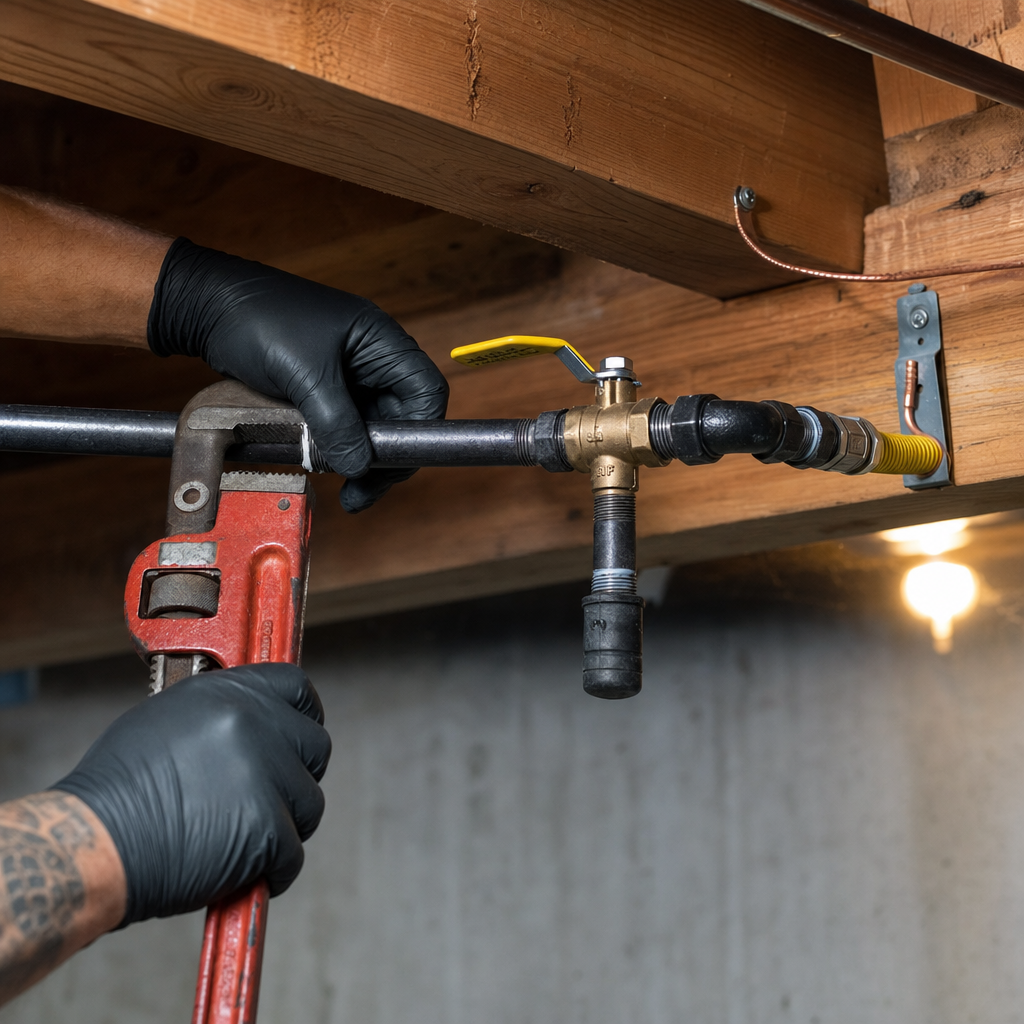
Gas work is the one area of residential plumbing where we won't bend on process, and it's worth explaining why rather than just saying no. A drain mistake makes a mess. A gas mistake makes the news. The permit and inspection process exists because the failure mode is not recoverable, and it's also — pragmatically — the thing that protects you at resale and with your insurer.
Here's what actually requires a permit in Washington, what the inspection involves, and what the unpermitted route really costs.
What needs a permit
Washington follows the Uniform Plumbing Code and the International Fuel Gas Code, adopted statewide and administered locally — Snohomish County for unincorporated areas, and the city for work inside Everett, Marysville, Arlington, Lake Stevens, Monroe, and the rest. Details vary a little by jurisdiction, but the general line is consistent.
Permit required:
- Running a new gas line to any appliance — range, dryer, fireplace, shop heater, generator, pool heater, outdoor fire pit, BBQ stub
- Extending, relocating, or resizing existing gas piping
- Converting an appliance from electric to gas
- Adding a new gas appliance to an existing system
- Replacing a section of gas piping
- Installing or moving a gas meter connection (utility coordinates, but house-side piping is permitted work)
Generally no permit:
- Replacing an appliance with a like appliance, connecting to an existing correctly sized stub, with no piping modification
- Replacing a flexible connector or a shutoff valve at the appliance
The dividing line is essentially: are you touching the piping system? If yes, permit. And the exemption is narrower than people assume — swapping a 30,000 BTU range for a 60,000 BTU professional range is not like-for-like, even though it looks like it, because the load on that branch changed and the line may no longer be sized for it.
Outdoor kitchen and fire pit lines are the ones most often run unpermitted, and they're a genuinely poor candidate for it: buried pipe, outdoor exposure, and a connection people forget exists. Buried gas line has specific requirements for material, depth, tracer wire, and riser protection. It needs the permit.
Who can legally do gas work
In Washington, gas piping is done by a licensed contractor carrying the appropriate specialty — plumbing or HVAC/gas piping — with the licensing, bond, and insurance behind it. Homeowners can pull permits for work on their own residence in many jurisdictions, and if you genuinely have the skills that's your right.
Our honest opinion on the homeowner path: gas is the wrong project to learn on. Sizing calculations, joint compound rated for the fuel, correct pipe material for the application, bonding, sediment traps, and pressure testing are all things where "looks fine, no smell" is not verification. The savings are not large relative to the risk.
Ask any contractor for their license number and check it on the L&I contractor lookup before work starts. Ours are on every page of this site.
What the inspection actually checks
Pipe sizing
The most common real defect, and completely invisible once the wall closes. Every appliance draws a certain BTU load, and the pipe has to deliver that at adequate pressure with everything running simultaneously — over the actual developed length of the run, including fittings.
Undersized line doesn't fail dramatically. It starves appliances. The furnace and water heater kick on together, the range flame drops off, burners run inefficiently and dirty, and eventually you get soot or a lockout. People chase that as an appliance problem for years when it's a pipe sizing problem from an addition done a decade earlier. This is why adding one appliance sometimes means upsizing the trunk.
Material
Black iron is the standard for interior runs. CSST — the flexible yellow or black jacketed stuff — is code-legal and fast, with specific bonding requirements. Copper is permitted for gas in some jurisdictions and not others; for buried runs, polyethylene with a proper riser. Galvanized is generally out for gas because the coating flakes and plugs orifices.
Bonding
CSST must be bonded to the electrical grounding system. This is a lightning issue — an unbonded CSST system can arc during a nearby strike and perforate the tubing, which is precisely as bad as it sounds. The bonding clamp and its conductor sizing get checked. It's frequently missed on DIY installs and by contractors who don't do much gas.
Sediment traps
A drip leg ahead of each appliance catches debris and condensate before it reaches a gas valve. Cheap, required, routinely omitted.
Shutoffs
Each appliance needs an accessible shutoff in the same room. "Accessible" means reachable without moving the appliance or opening a wall.
Support and protection
Piping supported at required intervals, and protected where it passes through framing — striker plates where a drywall screw or a picture nail could reach it.
The pressure test
This is the heart of a gas inspection. The new piping is isolated, capped, and charged with air to a specified test pressure, then held for a required duration with a gauge on it. The inspector wants to see the gauge holding — no drop.
The exact pressure and duration vary by jurisdiction and by the system's operating pressure, so we set it to whatever the local inspector requires. A drop of any amount means a leak, and then we soap every joint until we find it. There's no partial credit and no judgment call, which is exactly what you want from a gas test.
After the test passes and the system is put into service, we leak-check every joint under actual gas pressure with solution or an electronic detector, and verify appliance operation and combustion.
How the process runs
- Site visit. We look at your existing system, meter capacity, total connected load, and the route. This is where sizing gets calculated — not guessed from the length of the run.
- Permit application. We pull it under our license with the appropriate jurisdiction. Simple residential permits are usually quick; anything unusual can go to plan review.
- Installation. Pipe run, supported, protected, bonded, sediment traps and shutoffs set.
- Pressure test and inspection. Piping stays exposed. The inspector sees the gauge holding.
- Close-up and connection. Walls close, appliance connects, live leak check, combustion verified.
- Final sign-off. The permit closes out and stays in the county record, attached to your property.
That last step is worth dwelling on. A closed permit is a permanent public record that the work was done and inspected — which is what a buyer's agent, an appraiser, and an insurance adjuster all end up looking for.
What unpermitted gas work actually costs
At resale. Buyers' inspectors find unpermitted gas work regularly — visible new pipe with no corresponding permit history is not subtle. It becomes a negotiation item at best. At worst the buyer requires it permitted and inspected before closing, which now means retroactive permitting on a finished house, opening walls for inspection, on a deadline, with your sale hanging on it. That is the most expensive possible version of a permit.
Washington's seller disclosure form also asks directly about work done without permits. Answering it wrong is a problem beyond the plumbing.
With insurance. If a fire or explosion traces back to unpermitted gas work, the claim gets examined very closely. We're not insurance experts and coverage depends on your specific policy — but "uninspected gas line I installed myself" is not a fact pattern you want to be explaining to an adjuster.
Safety. The plain version: a small gas leak in an enclosed space accumulates, and it only needs one ignition source. The inspection catches the errors that produce that outcome, and it catches them from a person whose only job is finding them.
Leave the building. Don't flip switches, don't unplug anything, don't use your phone inside — any of those can spark. From outside, call your gas utility's emergency line or 911. Then call us at (360) 488-8553 for the repair once it's made safe.
The common jobs
The gas work we do most in this county: range lines for kitchen remodels, dryer conversions, garage and shop heaters, standby generators, outdoor kitchens and fire pits, fireplace inserts, upsizing trunk lines for tankless conversions, and repairing or capping lines from removed appliances.
That last one matters more than people expect. If you pull a gas appliance out, the line needs to be properly capped — not just a valve closed with a flex connector dangling. An abandoned live line behind a wall is a real hazard for whoever opens that wall next.
Every gas job we do is permitted, pressure tested, and inspected. Not because we enjoy the paperwork, but because it's the only version of this work we're willing to put our license behind. More on our gas lines and piping page, and if it's a tankless conversion driving the question, our honest take on tankless covers the gas sizing side in more detail.

Owner-operated, licensed, bonded and insured, working out of Granite Falls and serving all of Snohomish County. Questions about your own place? Call (360) 488-8553 — you'll get a plumber, not a call center.